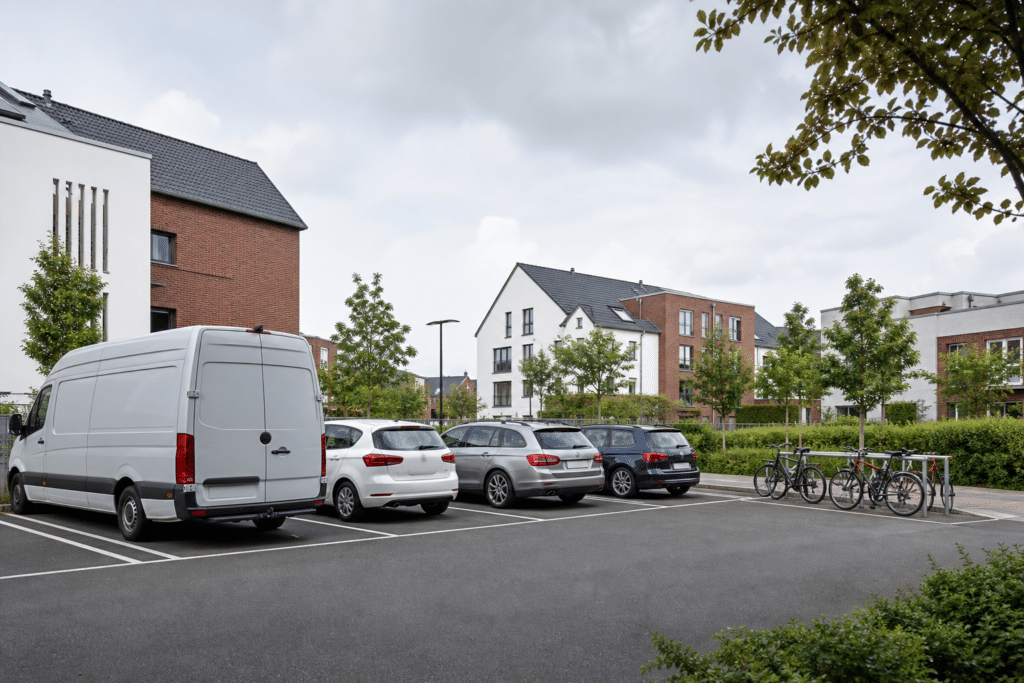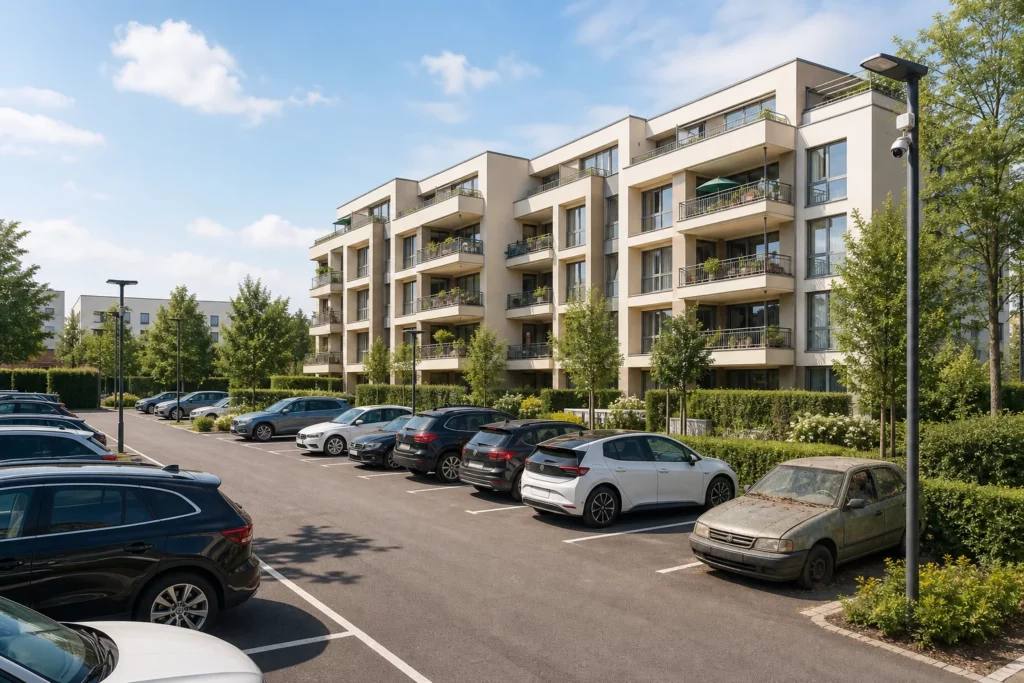
Parking discs, barriers, security staff, information signs: most operators have already tried to keep unauthorised parkers off their premises. Why these traditional measures are usually insufficient, and which solution is both sustainable and fair without disadvantaging their own customers.
The problem of unauthorised parking is well known. Many retailers and asset managers have tried out various measures in recent years. However, the standard solutions quickly reach their limits, and few of them reliably distinguish between genuine customers and unauthorised use.
Why traditional measures are often insufficient
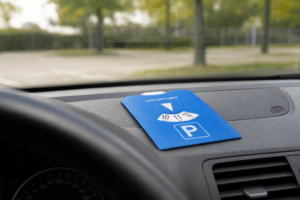
The requirement to display a parking disc is easy to circumvent and requires expensive on-site enforcement staff. Furthermore, it affects all parkers indiscriminately, including the business’s own customers who have simply forgotten to set their disc.
Whilst barrier systems prevent unauthorised parking, they cause traffic congestion at entry and exit points, incur maintenance costs for mechanical parts and result in a poorer user experience. Many retailers report that footfall initially falls following installation, as access is perceived as cumbersome.
Security services are the most expensive and least scalable option. Monitoring is patchy because it only takes place at certain times, and enforcement depends heavily on individual staff members and how they are on the day.
Signs and notices such as ‘For customers only’ have little effect. Without a system that actually detects and records breaches, the signage remains an empty threat that is ignored after a short time.
What does work instead: private car park monitoring using ANPR
The most effective solution to unauthorised parking is a system that automatically and reliably identifies who is authorised to park and who is not. This is precisely what ANPR-based car park monitoring – automatic number plate recognition – achieves.
Upon entry, a camera captures the number plate. Upon exit, it is captured again and the duration of the stay is calculated. If a vehicle exceeds the permitted parking time without authorisation, the case is investigated. The entire capture process runs automatically, without on-site staff and without a barrier. Customers who park within the permitted time are virtually unaware of the system.
Experience shows that, once an ANPR system has been installed, the proportion of unauthorised parkers falls significantly within a few weeks. The effect is long-lasting because the system operates continuously and without interruption, not just at specific monitoring times.
Fairness is not an option, but a prerequisite
A system that inadvertently treats customers in the same way as unauthorised parkers fails to fulfil its intended purpose and ultimately damages its own reputation. We therefore rely on graduated, transparent processes: clear signage that goes beyond the legal minimum, reasonable grace periods, a careful case-by-case assessment of borderline cases, and accessible channels for raising complaints.
Anyone who can prove that they were in fact a customer – for example, by showing a receipt or proof of eligibility – will have the contractual penalty waived. It is precisely this recourse that distinguishes a fair solution from a mere deterrent.
What exactly will change for your site
- More available places for genuine customers, who can therefore find a place more quickly
- Better real-time occupancy data: time of day, duration of stay, proportion of unauthorised parkers
- More satisfied tenants, as footfall increases and complaints about full car parks decrease
Summary
Illegal parking is a problem that can be solved, but only with the right approach. Traditional measures such as parking discs, signs or barriers do not provide a sustainable solution. Digital car park monitoring using ANPR technology, on the other hand, does – provided it is implemented fairly, transparently and with the customer experience in mind.